
A physician does not fail a patient by not knowing enough. A physician fails a patient when the system is too slow to act on what is already known. I left medicine to fix that failure at scale, and Intent Powered HCP Suite is the furthest we have gotten. It is also why we chose to launch it the way we did, the night before Fierce Pharma Week even opened, with three hundred drones over Philadelphia instead of a slide at a podium.
The Bargain We Have Quietly Accepted
Most HCP media today is still planned on claims data. Claims are thorough, but they are slow by design, a prescription written today typically does not surface in a claims derived audience for several weeks, after adjudication, aggregation, and modeling. By the time a brand activates against that segment, the clinical decision behind it has already been made, and often remade.
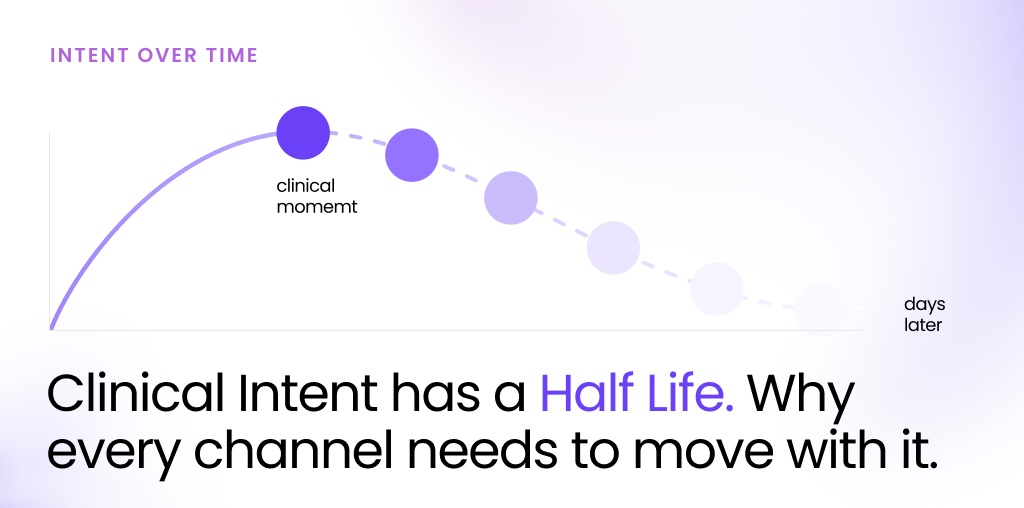
I have said this before because I believe it is the single most under-examined fact in our industry. We pay real time prices for reach, and then we aim that reach using data that is several weeks old. Clinical intent has a half-life. A physician's question about a therapy, a new diagnosis entered into the chart, a formulary check; these are the moments that predict what happens next, and they decay in days, not quarters.
What We Actually Built
Intent Powered HCP Suite brings three of the largest channels in pharma media, Connected TV, Social, and Programmatic, under the same orchestration layer that already runs Care Sequence and our DOOH offering. Each one is now driven by the same Clinical Intent Signals, read from EHR workflow activity, from engagement across our network of 2000+ medical publishers, and from point of care interactions captured through our Triggers layer across more than 185+ EHR and platform integrations. Every signal resolves deterministically to a verified NPI through our identity graph of more than six million healthcare professionals. No probabilistic lookalikes. No inferred audiences.
What that makes possible is not a bigger reach number. It is a shorter distance between a signal and a response. A signal captured at the point of care can shape a CTV exposure that same evening, a LinkedIn placement the next morning, and a programmatic follow up the day after, all measured back to the same physician, and eventually to the prescription itself. Brands no longer need one plan built for reach, and a second plan built for relevance. When one clinical signal drives every channel from a single command layer in Daily Command, there is only one plan.
Why I Keep Returning to the Ethical Question
People ask me, reasonably, whether reading a physician's intent this closely crosses a line. I want to answer that directly rather than around it. Reading intent is not the same as shaping it. Nothing in this system manufactures a decision or nudges a physician toward one. It reads signals doctors already generate in the ordinary course of their own work, and it surfaces them, so the right information reaches the right physician while the question is still open. The decision stays exactly where it has always belonged, with the physician, made independently, on clinical merit.
What changes is the quality of what reaches them in that window. A physician working through a real therapeutic question is better served by one relevant, well-timed message than by the undifferentiated volume most of our industry still calls a media plan. That is not a heavier hand on the scale. It is a lighter one, and a more honest one.
The Night Before the Week Began
We announced the Suite on the morning of September 14, and that same night, on a rooftop above Philadelphia, three hundred drones lit up the sky in a formation built around a single idea, Clinical Intent Signals, before moving through the channels those signals now power. I wanted the industry to feel the idea before it read the spec sheet, because the idea itself is not really about technology. It is about respect for how little time a clinical decision actually gives you, and whether our industry is willing to move at the speed that decision demands.
The next day, I sat down with Maria Menounos to talk about what actually happens in the minutes before a prescription is written, from both sides of that moment. The drone show and that conversation are the same thesis told two ways. One in light, one in words. Healthcare marketing has spent twenty years reading the prescription after it happened. A physician does not fail a patient by not knowing enough. Our industry has been failing physicians, and the patients behind them, by being too slow to act on what it already knew. The Intent Powered HCP Suite is not the end of that failure. It is the furthest we have gotten toward fixing it.
— Harshit Jain, MD Founder & Global CEO, Doceree