
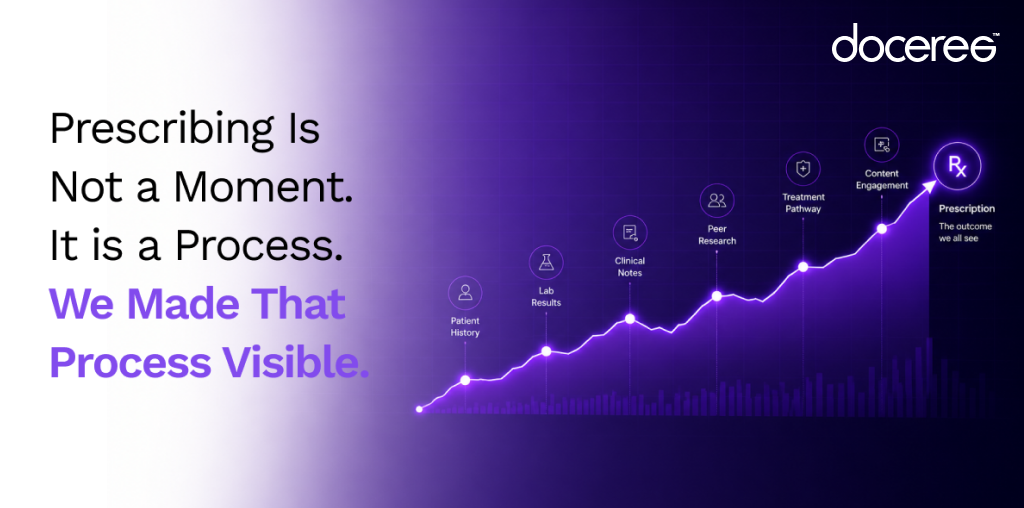
There is something I have never been able to shake since I left medicine. When I was a physician, the moment I reached for a prescription pad was never a moment. It was the end of a long, invisible process — weeks of reading, questioning, comparing, consulting colleagues, revisiting guidelines. A decision that had been forming long before it was made.
Healthcare marketing kept trying to reach me at the moment I signed. It was always already too late.
That is the problem Clinical Intent Signals was built to solve. It is the first real-time clinical intent layer our industry has had — a way to engage a physician based on where they are in their thinking right now, not on what they prescribed last quarter.
What CIS Reads
CIS reads the signals a physician generates in the ordinary course of practice — the questions they look up, the guidance they check, the patterns in how they diagnose and treat — and it reads them as they happen, not from a claims file that surfaces months later. These are real signals of clinical decision-making, not behaviour inferred after the fact. And they are physician-level, never patient-level, handled inside the privacy and compliance lines our industry rightly insists on.
What that means is something the field has never really had: the ability to meet a physician where they are in their thinking, not where a six-month-old dataset says they used to be. Intent shows up weeks before it would ever appear in prescribing data — and the right message can reach them while the decision is still live, not after it has been made.
We tested this. Over twelve weeks, across 36,000 matched HCPs in several therapeutic areas, campaigns running on CIS moved them through the decision journey 38% faster, earned 27% more engagement in context, and used media 21% more efficiently than matched controls. I don't offer those numbers as a victory lap. I offer them because they point to something simple: when marketing moves with how clinicians actually decide, instead of running alongside and guessing, everything works better.
Why It Took This Long
The honest answer is that the data was always fragmented. The signals of clinical decision-making lived in separate places — records, journals, point-of-care tools, the field — disconnected and largely out of reach for the commercial side of the business. So marketing did the best it could with what it had: better segmentation of old claims data, smarter targeting of lists, more sophisticated accounts of what had already happened. All of it looking backward. All of it aimed at a physician who, by the time the message landed, had already moved on — because the one who had prescribed was never the one you needed to reach.
This problem was solved years ago everywhere else. Reaching people based on what they are doing right now, rather than a fixed profile, has been ordinary practice in technology and financial services for over a decade. Healthcare didn't get there — not for lack of ambition, but because the underlying clinical data was never connected. The signals existed. The way to read them didn't.
That is what we set out to do.
Why No One Can Shortcut This
Let me say something that might sound strange coming from the person whose company built it: the intelligence was never the hard part. Capable AI is fast becoming table stakes — every platform in this market will have it before long, and the moment everyone has it, it stops being an advantage.
The hard part — the part you can't buy, and can't stand up in a quarter — is being close enough to the clinical moment to read intent honestly, as it forms, instead of inferring it from a comfortable distance. That kind of proximity takes years to earn. It was never going to come from cleverer analysis of the same old data. It had to come from being where the decision is actually taking shape.
Why This Matters Beyond the Numbers
Eight years ago, I walked away from medicine with one question I couldn't stop asking: Why does a physician prescribe what they prescribe? I knew the answer wasn't in a claims database. I knew it was somewhere in the process — the reading, the doubting, the pattern-matching that happens before any decision is made.
Clinical Intent Signals is the first time that process becomes legible to the people responsible for reaching physicians — so let me be direct about how that can sound. Reading clinical intent is not the same as shaping it. CIS doesn't manufacture a decision or push a physician toward one; it reads signals doctors already generate in the ordinary course of their work and surfaces them so the right information reaches the right physician at the right moment. The decision stays exactly where it has always been — with the physician, made independently, on the clinical merits.
What changes is the quality of what reaches them: a doctor working through a therapeutic question is better served by one relevant, well-timed message than by a flood that ignores where they are. That is not a heavier hand on the scale. It is a lighter one. The line has never been about whether we can read a physician's process; it is about whether we respect their judgment. We do. The information was always there — we simply lacked the architecture to read it.
What we have launched is not a feature. It is a category — intent-based engagement, the model the industry has been drifting toward for years without a way to actually get there. Now there is one. It goes live on July 14, alongside Daily Command, and we built it deliberately as a foundation rather than a fortress: not a private advantage for one brand, but something the whole industry can stand on. The real shift is small to say and hard to build — closing the distance between knowing where a physician is in their thinking and being able to act on it while it still matters.
Healthcare marketing has been looking in the rearview mirror for twenty years. What we built is a windshield.
— Harshit Jain, MD Founder & Global CEO, Doceree