
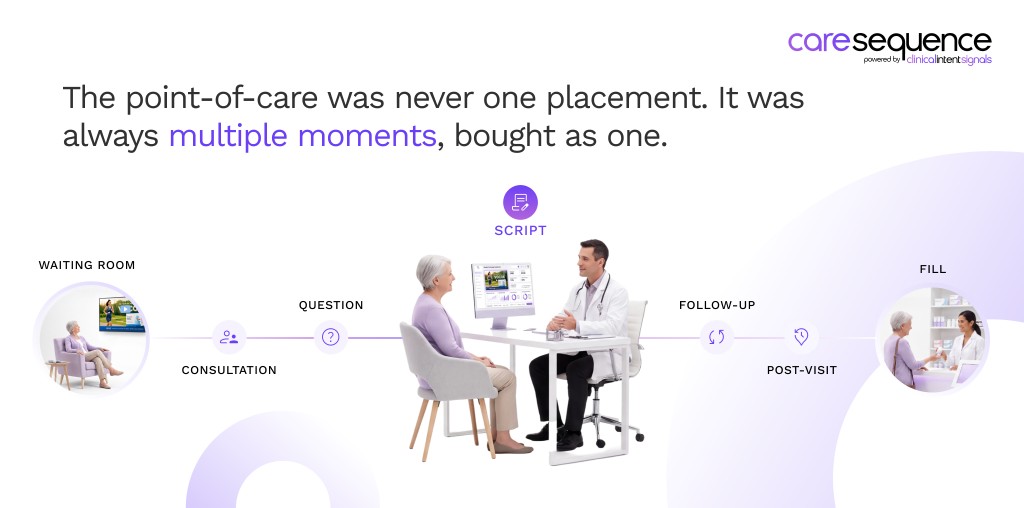
A patient can be prescribed the right medicine and still never take it. Not because the diagnosis was wrong or the physician was unconvinced, but because of what happened after the exam room door closed. A cost that surprised them. A question nobody was there to meet. And a pharmacist at the counter, holding the last word on a brand's script, who has never once been part of the conversation.
A prescribing and fulfillment decision is not one moment. It is a chain of multiple moments of care. The patient waiting, worried about something they read online. The consultation, where a physician starts forming a decision. A question raised mid-visit. The script itself, written with a dosage and interaction history the patient will never see. A follow-up, keyed to what was just prescribed. The patient's own decision, after the visit, about whether to act on it. And the pharmacist at the counter, deciding whether a brand holds or gets substituted away.
Multiple care moments. One visit. Our industry has bought media as if only one of them was reachable, usually the one in the exam room, and usually too late to change anything downstream.
This week we launched Care Sequence. I want to explain the reasoning behind it, because the reasoning matters more than the announcement.
We kept optimizing the wrong unit
Healthcare marketing measures itself in impressions and touchpoints. A banner in the waiting room. A message in the EHR. An email after the visit. Each gets its own budget, its own vendor, its own report, as if a physician's decision to prescribe and a patient's decision to fill happen on separate planets.
They do not. A prescribing and fulfillment decision passes through several moments and three stakeholders: the patient in the waiting room, the physician through consultation and script, the pharmacist at the counter. Brands are judged on prescriptions written, filled and refilled, yet a single point-of-care buy has only ever reached one moment in that sequence. You can win the impression and still lose the outcome, because the outcome was never decided in one place.
What actually holds a visit together
The thing that connects the waiting room to the pharmacy counter is not a persona or a media plan. It is a real clinical signal, a confirmed ICD-10, CPT or NDC code entered at the source. That signal exists inside the EHR, the e-prescribing system, the pharmacy management system, whether or not a marketer ever sees it.
Care Sequence reads that signal directly and activates them, in order, off that event. That is one continuous thread from a single verified fact about one patient's care, rather than separate campaigns that happen to run at similar times.
I said this at launch and it is worth repeating here. A prescription written is not a prescription filled. For twenty years we built around the one moment anyone could sell. Everything after it happened where no brand could go.
The moment nobody could reach
The last moment in the sequence is also the one that has stayed closed the longest. When a script arrives, the pharmacist processes it in the pharmacy management system, the final point at which brand value is reinforced or lost to a switch. Manufacturers have reached patients at the shelf for years. Reaching the pharmacist, in workflow, on the live NDC, as that script is processed, has not existed as a media placement before now.
I wrote prescriptions for years without ever knowing which of them survived that counter. Point of Dispense is the part of this I take most personally.
Why we priced it as one thing
Care Sequence is charged once per qualified clinical visit rather than per touch. A coded clinical event qualifies the visit, and one price covers all three stakeholders, in place of the separate line items and separate reports each moment has required until now. Every activation runs on approved business-rule logic against verified identity, so the trigger fires on a clinical rule, never a patient record.
If the visit is one event, the buy should be too. Anything less asks marketers to reassemble a patient's care out of separate purchases, and stitch the meaning together themselves.
What I would ask you to sit with
Every pharma marketer I have spoken with knows their message reaches the physician, the patient and the pharmacist at different times, through different systems, from different vendors. Most have accepted that as the cost of a fragmented system.
I do not think it has to be. The infrastructure already exists to treat a visit as one event: 150+ direct EHR integrations, 35+ health system partnerships, 40,000+ pharmacies nationwide, a signal verified at the source, and measurement that closes the loop back to real prescribing, NRx, TRx and NBRx, instead of stopping at the impression.
A visit does not fragment on its way from the waiting room to the counter. Only our marketing has. The standard going forward should be simple: a brand shows up for the whole encounter, priced and measured as one thing, because it always was one. Care Sequence is our attempt at that standard. I would rather hear what you think still happens invisibly between the script and the counter than tell you we have solved for all of it.
— Harshit Jain, MD Founder & Global CEO, Doceree